Manuscript — Automation in Construction
Subsurface defects such as layer debonding, moisture-induced damage, and pipe leakage can compromise pavement structural integrity long before visible surface distress appears. In this review, Qiqin Yu and Xiaowei Luo (City University of Hong Kong) systematically examine how non-destructive testing (NDT) and data-driven methods—particularly ground penetrating radar (GPR) interpreted with machine learning and deep learning—support road pavement subsurface condition evaluation.
Following a PRISMA-style literature search on Web of Science, 140 publications were selected from 287 retrieved records. The review is organised around four application domains:
- Structural layer characterisation — dielectric constant, layer thickness, rebar detection, and interlayer debonding
- Subsurface anomaly detection — moisture, cracks, and cavities
- Subsurface pipeline evaluation — leakage and utility assessment
- Data-driven frameworks — preprocessing, training pipelines, and synthetic data generation (e.g. gprMax)
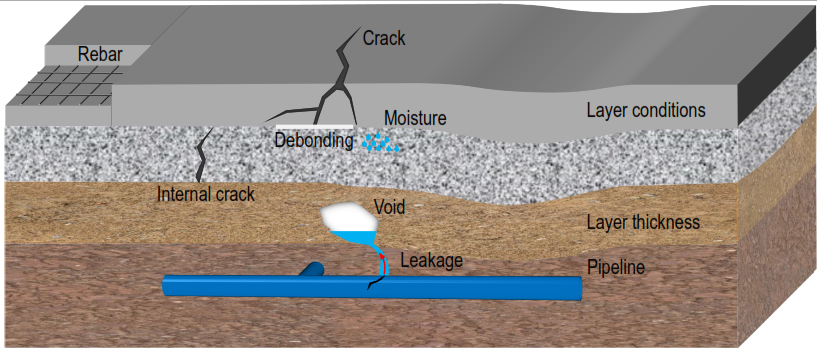
Pavement subsurface layers and anomalies reviewed in this study
Key findings
- Dielectric constant estimation and layer interface detection remain central to structural characterisation; CNN-based methods are increasingly applied alongside conventional inversion and thresholding approaches.
- For moisture, crack, and cavity detection, simulation-based training (e.g. gprMax) is widely used to offset scarce labelled field data, though simulation-to-real transfer remains a major limitation.
- Multi-sensor fusion (e.g. GPR with ERT or infrared) and 3D GPR are emerging to improve detection robustness at the network level.
- Future priorities include larger and more diverse field datasets, adaptive preprocessing, few-shot learning, and validated deployment under varied pavement structures and environmental conditions.
Research highlights
- Systematic review of 140 publications on NDT and data-driven pavement subsurface evaluation
- Covers structural layer characterisation, subsurface anomaly detection, and pipeline evaluation
- Analyses data-driven frameworks including preprocessing and synthetic data generation
- Identifies future research priorities for network-level subsurface condition assessment
Keywords: Ground penetrating radar · Non-destructive testing · Pavement condition monitoring · Road subsurface · Deep learning